
Post-Abatement Asbestos Air Clearance Testing in Michigan
Independent Post-Abatement Asbestos Air Clearance Testing You Can Rely On
Fast scheduling. Defensible results. Contractor-friendly execution.
Third-party post-abatement asbestos air clearance testing is the final step required before a regulated area can be reoccupied following asbestos abatement activities in Michigan. Michigan Asbestos Testing, LLC provides independent, third-party asbestos air clearance testing for residential, commercial, and institutional projects across Michigan.
Our clearance testing is performed in strict accordance with AHERA, NESHAP, and Michigan regulatory expectations, ensuring results that stand up to contractor review, owner reliance, and regulatory scrutiny.
Regulatory Standards for Asbestos Air Clearance Testing in Michigan
Post-abatement asbestos air clearance testing is performed to verify that asbestos fiber concentrations meet applicable regulatory and industry standards prior to re-occupancy. In Michigan, asbestos abatement projects are subject to oversight under federal and state regulations, including AHERA, NESHAP, and EGLE requirements.
Final air clearance testing is typically conducted using Phase Contrast Microscopy (PCM) and is evaluated against widely accepted clearance criteria, commonly requiring airborne fiber concentrations at or below 0.01 fibers per cubic centimeter (f/cc). Clearance testing must be performed by an independent, third-party asbestos professional to ensure objectivity and regulatory compliance.
What Is Asbestos Air Clearance Testing?
Asbestos air clearance testing verifies that airborne fiber concentrations inside a regulated area are below acceptable clearance limits following asbestos abatement activities.
Clearance testing typically includes:
- Visual inspection of the work area
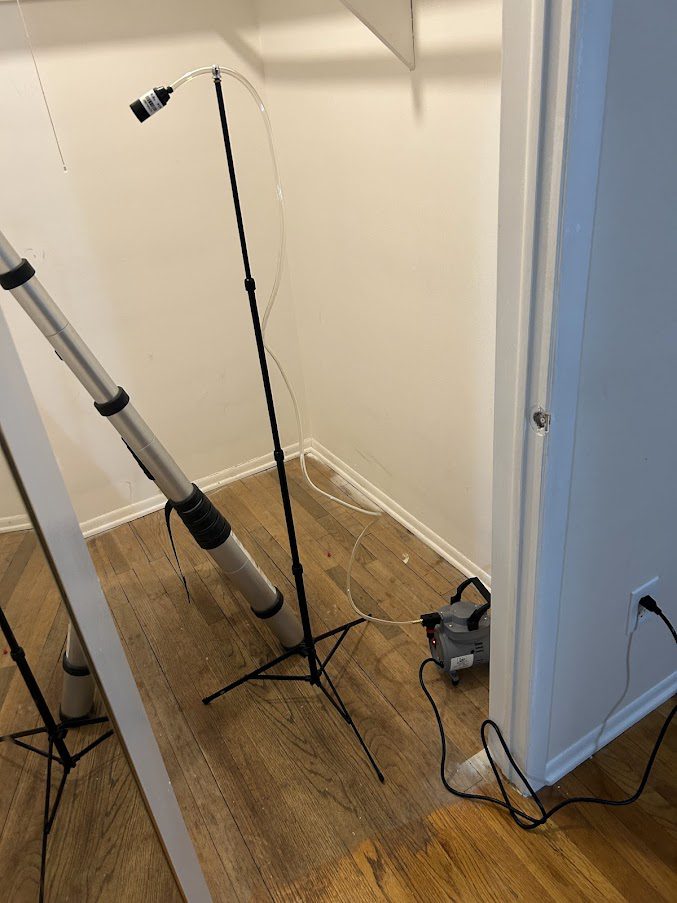
- Aggressive air sampling within containment
- Phase Contrast Microscopy (PCM) analysis
- Clearance documentation suitable for owner, contractor, and regulator use
Without successful clearance results, containment cannot be removed and the area cannot be legally reoccupied.
Why Independent Clearance Testing Matters
Asbestos clearance testing must be independent of the abatement contractor to avoid conflicts of interest and compliance issues.
Michigan Asbestos Testing provides:
- True third-party clearance testing
- No affiliation with abatement contractors
- Defensible documentation for:
This independence protects you, your client, and your project schedule.
Our Post-Abatement Clearance Process
We follow a structured, regulator-defensible methodology:
1. Final Visual Inspection
- Verification that all asbestos-containing material has been removed
- Confirmation that no visible debris, dust, or residue remains
- Documentation of inspection findings
2. Aggressive Air Sampling
- Use of leaf blowers and air disturbance per AHERA protocols (when appropriate)
- Sampling performed inside containment
- Chain-of-custody maintained throughout
3. Laboratory Analysis
- PCM analysis by NVLAP-accredited laboratories
- Optional TEM analysis, when required by contract or regulator
- Expedited turnaround available
4. Clearance Documentation
Upon completion of air clearance testing, clients receive a written clearance report documenting:
- Clear pass/fail determination
- Sampling locations and volumes
- Sampling locations and air volumes are determined based on the size and configuration of the abatement area, as well as information documented in the asbestos survey.
- Lab results and any applicable regulatory references
- Contractor-ready final report
- A final report for the homeowner
Standards for Clearance
Post-abatement clearance testing is typically evaluated against:
- ≤ 0.01 fibers/cc (PCM) for reoccupancy
- Additional criteria as specified by:
- Project specifications
- Owner requirements
- Regulatory agencies
- Consultant or engineer of record
We ensure the correct method is applied for your specific project, avoiding re-sampling delays and failed clearances.
Independent Clearance Testing vs. Contractor-Performed Testing
Post-abatement asbestos air clearance testing must be conducted independently to ensure objective results and regulatory acceptance. The table below outlines the difference between independent clearance testing and testing performed by an abatement contractor.
| Independent Clearance Testing | Contractor-Performed Testing |
|---|---|
| Performed by a third-party asbestos consultant | Performed by the abatement contractor |
| No financial interest in the abatement outcome | Direct financial interest in project completion |
| Objectively verifies clearance criteria | Inherent conflict of interest |
| Results are defensible and regulator-acceptable | Results may be challenged or rejected |
| Commonly required for compliance and close-out | Often not accepted for final clearance |
| Protects property owners and occupants | Primarily benefits contractor timelines |
Independent clearance testing helps ensure that asbestos fiber concentrations meet applicable clearance criteria prior to re-occupancy. Regulatory agencies, property owners, and facility managers typically require clearance verification to be performed by an independent third party to avoid conflicts of interest and to provide defensible documentation.
Michigan Asbestos Testing does not perform asbestos abatement and operates exclusively as an independent asbestos testing and consulting firm.
Independent, Third-Party Clearance Verification
This separation ensures that clearance results are objective, reliable, and acceptable to regulators, property owners, contractors, and other stakeholders.
What Happens If Asbestos Air Clearance Testing Fails?
If post-abatement asbestos air clearance testing does not meet applicable clearance criteria, the area is not approved for re-occupancy. A clearance failure indicates that airborne asbestos fiber concentrations exceed acceptable levels or that conditions within the regulated area require correction.
When clearance criteria are not met, the following steps are typically required:
- Identification of potential issues, such as residual asbestos debris, inadequate cleaning, or disturbed containment
- Additional cleaning or corrective work performed by the asbestos abatement contractor
- Re-inspection and repeat air sampling following corrective actions
- Verification testing to confirm that clearance criteria have been achieved
Clearance testing continues until acceptable conditions are verified and documented.
Independent clearance testing helps identify unresolved issues before re-occupancy, protecting occupants, property owners, and contractors from potential exposure and regulatory complications. A failed clearance does not necessarily indicate improper abatement, but it does require correction and confirmation prior to project close-out.
Michigan Asbestos Testing provides objective clearance verification and documentation to support safe re-entry and regulatory compliance.
Does a failed clearance mean the abatement was done incorrectly?
Not necessarily. Clearance failures can occur due to residual dust, disturbed surfaces, or post-abatement conditions that require additional cleaning. Independent testing ensures these issues are identified and addressed before re-occupancy.
Who Requires Post-Abatement Air Clearance Testing
Post-abatement asbestos air clearance testing is commonly required for:
- Asbestos abatement contractors seeking compliant project close-out documentation
- Property owners and building managers verifying safe re-occupancy
- Commercial and industrial facilities with regulated asbestos work
- Public and institutional buildings subject to AHERA or NESHAP oversight
- Real estate transactions involving asbestos abatement prior to sale or occupancy
- Homeowners who have had recent asbestos abatement
Independent clearance testing provides assurance that asbestos fiber levels meet applicable standards and that the space is suitable for re-entry.
If containment removal is waiting on clearance, we understand the urgency.
Typical Air Clearance Testing Timeline
Most post-abatement clearance testing follows this general timeline:
– Final cleaning and visual inspection by the abatement contractor
– Independent air sampling conducted within containment
– Laboratory analysis by an accredited lab
– Written clearance report issued upon acceptable results
Turnaround time varies by project size and laboratory requirements, but results are often available within one to three business days.
Frequently Asked Questions About Asbestos Air Clearance Testing
What clearance level is considered acceptable after asbestos abatement?
Clearance criteria commonly require airborne fiber concentrations at or below 0.01 f/cc when analyzed by Phase Contrast Microscopy (PCM), unless project specifications require otherwise.
Is clearance testing required after all asbestos abatement projects?
Clearance testing is typically required for regulated asbestos abatement projects prior to re-occupancy, particularly for commercial, industrial, institutional, and public buildings, and when required by project specifications or regulators.
Can the asbestos removal contractor perform clearance testing?
No. Clearance testing must be conducted by an independent third party to avoid conflicts of interest and ensure regulatory acceptance.
How soon should clearance testing be scheduled?
Clearance testing should be scheduled as the abatement project approaches completion to avoid delays in containment removal and re-occupancy. Early coordination helps ensure timely sampling and reporting.
Why Contractors Choose Michigan Asbestos Testing
- Fast response and flexible scheduling
- Clear communication with site supervisors
- No unnecessary delays or over-sampling
- Reports written for real-world use—not boilerplate
- Statewide Michigan service coverage
Our goal is simple: get you a defensible clearance as efficiently as possible—without cutting corners.
Serving All of Michigan
We provide asbestos air clearance testing throughout Michigan, including residential, commercial, and industrial projects. Whether your project is in a major metro area or a rural community, we can support your clearance needs.
Schedule Asbestos Air Clearance Testing
If your project is approaching completion, schedule clearance testing early to avoid downtime.
Contact Michigan Asbestos Testing, LLC today to arrange post-abatement asbestos air clearance testing and keep your project moving forward.